Guest blog: A Future Without Rubbish
- Environment
Can you imagine a world without rubbish? Our latest guest blog comes from small grantee A Future Without Rubbish (AFWR), a nonprofit helping to clean up our environment. Read on to discover more about their mission from founder, Luke Douglas-Home.
Beneath the parks where children play, beneath the car parks where you leave your car on a Saturday morning, and beneath some of the most cherished stretches of our coastline, are ticking pollution time bombs – most people have never heard of the problem of historic landfill sites.
For decades, in some cases, centuries, waste was buried in the ground with little regulation and even less monitoring. The sites were closed, built over, and largely forgotten. But the environmental and public health risks they carry did not go away… and in many, many cases, they are no longer dormant, safe, or passive.
In fact, these sites buried beneath our feet, beside homes, waterways, coasts and schools contain our industrial past, and they cast a very long shadow that darkens, and darkens… often with completely catastrophic effects. No small issue, but that is the problem AFWR has set out to address, and it is why the support of King Charles III Charitable Fund has meant so much to our work – and, we hope, for all of us in time.
AFWR is a community interest company founded on a simple but urgent principle: that our environment must not be used as a long-term repository and attenuator for the consequences of our short-term thinking. After all, our environment is us, and we are it. By polluting our environment, we pollute ourselves.
Our flagship methodology, ISRRA™ (Initial Site Risk and Responsibility Audit), was developed for and by local councils, landowners, developers and communities as a rigorous, standardised tool to identify and quantify the risks posed by historic landfill sites on or near their land.
ISRRA™ is consistent with the Environment Agency Stage 1 Land Contamination Risk Management guidance, and every report we produce is validated by AFWR, the methodology owner and validation authority.
The methodology emerged from years of frustration after The Coastline Runner first became aware of it while running our coastlines. Historic landfill sites in England number in the tens of thousands, yet there is no mandatory requirement to assess the vast majority. Councils are often told by higher tiers of government that responsibility for monitoring “falls outside our remit.” Landowners may not even know a landfill exists beneath or beside their property. And in coastal and rural communities, already facing disproportionate environmental pressures, the risks can be acute: leachate reaching sensitive habitats, methane generation near residential areas, and the slow, invisible migration of contaminants into soil and water that nobody is measuring.
Thanks to initial work for The Crown Estate, local councils and landowners, and then support from King Charles III Charitable Fund, AFWR has been able to further develop ISRRA™ from concept to practice. We have now completed audits across England, presenting findings to local councils from Skegness in Lincolnshire, to Merseyside, to Lewes in East Sussex.
In every case, our work has prompted action at a higher tier of government, exactly the outcome the methodology was designed to achieve. In Skegness alone, we identified five historic landfill sites within the town, three of which we assessed as presenting a ‘high risk’ to the surrounding environment and community, and before the ISRRA™, Skegness Town Council (STC) “were unaware of the existence of such sites”. The higher local authority’s initial response to STC, that the sites were “suitable for current use”, underlines precisely why truthful, independent audits matter, and why ISRRA™ should exist as a credible, evidence-based challenge to institutional complacency.
In April 2026, we presented ISRRA™ to Lewes Town Council, a community sitting above a chalk landscape that is both ecologically precious and particularly vulnerable to groundwater contamination. Conversations and presentations have led to the commissioning of a full ISRRA™ audit for the town, a process that will identify known and unknown risks and quantify them using a standardised rubric that councillors, residents, and future developers can all rely upon.
None of this work happens in isolation. AFWR operates with a small but dedicated team, and the support of the King Charles III Charitable Fund has allowed us to develop our intellectual property framework, invest in our research capacity, and begin recruiting the practitioners who will carry ISRRA™ forward.
The connection between historic landfill and our wider environmental crisis is not always obvious, but it is profound. These sites represent hidden carbon liabilities, potential pollution sources, and a legacy of environmental injustice that falls hardest on those with the least power to challenge it. With the right tools, methodology, and partnerships, that legacy can be mapped, understood, and ultimately addressed.
For more information, visit afwr.org or contact info@afwr.org.
Some useful links to discover more:
- The Coastline Runners’ Mission: Here
- Luke Douglas-Home is a Chartered Environmentalist and The Coastline Runner. C5’s Hero of the Week!
More news
Guest blog: Project Seagrass make meadows in North Wales
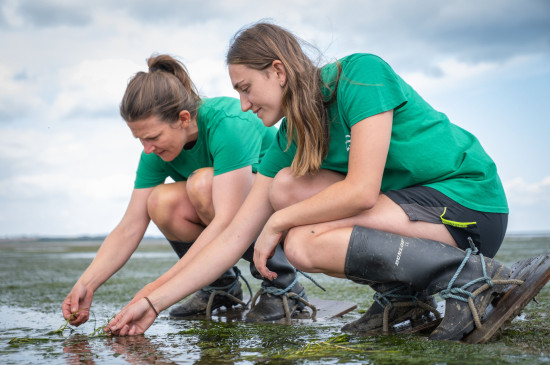
Thousands of seagrass shoots have been planted in the Thames, as we kick off work to transform one of the world’s most famous waterways