Guest blog: Project Seagrass make meadows in North Wales
- Environment
This month, our guest blog is from strategic partner Project Seagrass, who work to restore and protect seagrass meadows. Thank you to Ollie, Senior Science Officer, for writing this blog about their work in North Wales.
Setting the scene
September brings a change of pace at Project Seagrass. Following another busy summer of fieldwork and seed collection, the autumn provides an opportunity to pause, take stock, and reflect on this season’s work.
Our thoughts return to early spring 2026 on Ynys Môn. As part of this year’s restoration efforts, the team planted 350,000 tiny seagrass seeds beneath the golden sand, each one carrying the possibility of new life; the best chance of germination and survival ensured through careful planning based on science.
In August 2026, we gathered the next generation of seagrass seeds for next year’s planting. Our team headed to Wales’s largest seagrass meadow in Porthdinllaen on the Llŷn Peninsula, where snorkellers, divers, and wading volunteers worked patiently beneath a warm North Wales sun. Together, they carefully collected seed-bearing shoots by hand—a harvest of hope for the following spring.
With the planting and harvest over, and our seeds safely in storage until out planting next spring, we can step back to reflect on progress. There is, however, one final trip to undertake for the 2026 field season: Autumn monitoring. Despite its uninspiring name, our Autumn monitoring is perhaps our most exciting fieldwork and the apex of a year’s hard work.
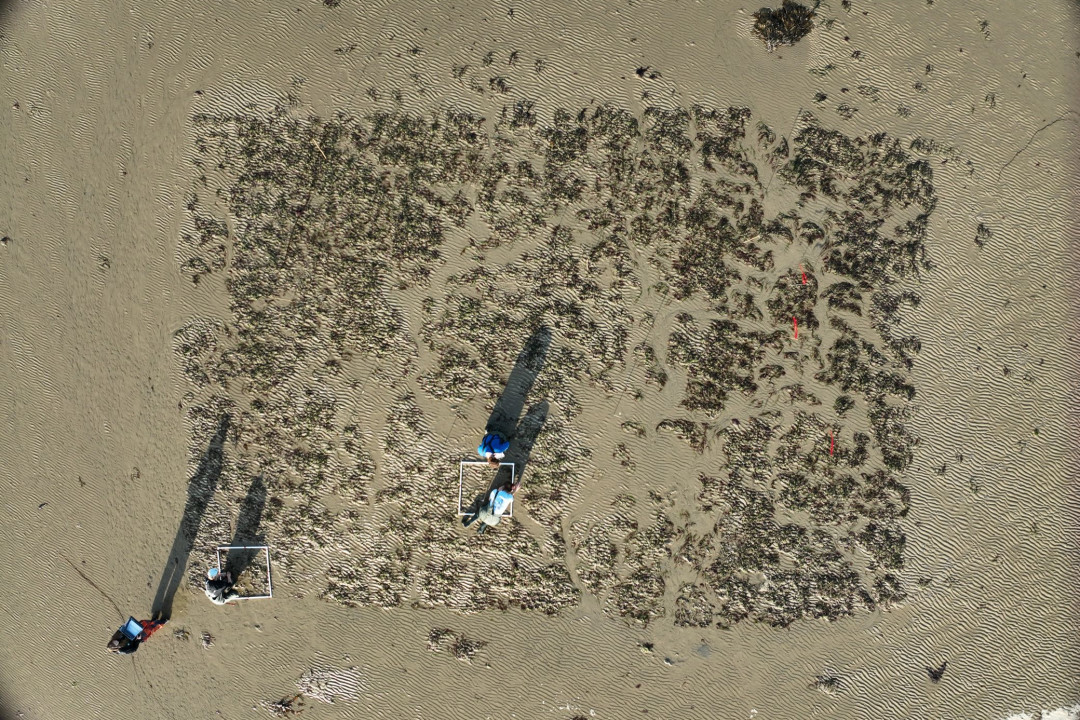
In mid-September when the tides were at their lowest, we once again travelled up to North Wales from Glamorgan to Ynys Môn. Here across the glittering waters of Holyhead Bay we assessed the impact of our spring planting. Using drones and teams on foot we meticulously recorded the density of tide-soaked plants whose dark green leaves now appeared to cover our planting plots.
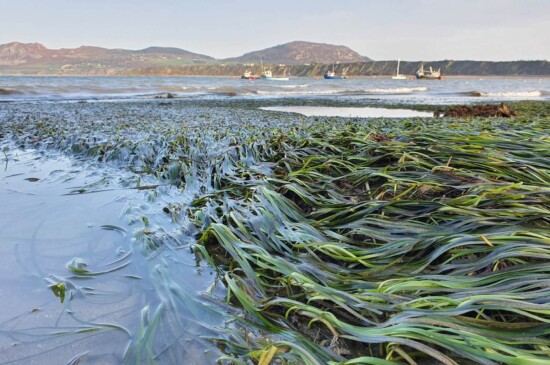
The lower portion of this beach has undergone a dramatic transformation since our planting back in spring. Where previously only bare sand appeared, seemingly featureless aside from the occasional transitory hermit crab, the beginnings of a brand new meadow have now emerged. Seeds have grown in to fully mature plants which, despite their small size, have already begun engineering the very environment they now inhabit.
Seagrass plants spread anchoring rhizomes (large root-like structures) beneath the surface of the sand creating a complex lattice, a habitat in its own right, as well as a net holding the sediment together. The leaves of the seagrass form a canopy under the waves, providing shelter for fish and invertebrates and an important buffer to our coastlines from erosion. By reducing the impact of waves, fine organic partials can become trapped within this meadow, sand will make way for mud, and, in timescales longer than our lifespans, carbon will be pulled in and stored under this beach.
Staring across this now verdant scene, we can breathe a sigh of relief. A habitat which had been absent for over a century in this bay, has begun its return, and with it a valuable natural resource enshrined for generations to come.
The Facts
October monitoring in 2026 concludes the third year of seagrass monitoring in Holyhead Bay. Since 2024, Project Seagrass alongside partners from the Seagrass Ocean Rescue North Wales programme have planted approximately 1.3 million seeds in the intertidal sediments surrounding the bay. This ties into a programme of seagrass restoration across North Wales, where a total of 2.7 million seeds have been planted since 2023 across four distinct locations.
Whilst this year indicates the beginnings of success, restoration is never simple. With each success there is often a plethora of failures or learnings (trials). For example, a marine heatwave on the Llŷn Peninsula in early Summer 2024 caused the complete mortality of the 500,000 seagrass seeds planted that year. Instead of viewing this as a setback, we used this experiences an opportunity to learn what had gone wrong and to examine how we could mitigate against this happening again. The early success we have seen this year is very much a legacy of following our science-led approach.
Enshrining the involvement and engagement with local communities in every aspect of the restoration process has also been a vital component of this project. Since 2023 volunteers, many locals to North Wales, have given over 7000 hours of their time bringing active restoration to fruition.
Through facilitating initial interactions with local meadows and providing opportunities for volunteers the program can hopefully aid the local community to better understand and connect with these habitats. This includes getting volunteers to experience planting, seed gathering, and monitoring using citizen science apps like Seagrass Spotter. This will ideally lead to community stewardship for the meadows after programme completion.
The hope for the restored seagrass currently growing across Holyhead Bay is that it continues to thrive in the months and years to come, becoming a shared resource for the people of Ynys Môn, and indeed the planet.
How can you help?
Restoration is a collaborative process. At Project Seagrass our work is rooted in science, grounded in communities, and focused on turning evidence into action to meet the challenges of a changing Ocean. With support, we can restore and protect seagrass meadows while inspiring more people to take part in Ocean recovery.
The Project Seagrass Our Ocean Is Changing campaign hopes to fund vital research, essential restoration activities including seagrass planting and monitoring, specialist equipment, community volunteer events, citizen science programmes and education initiatives that connect people with their local coast.
Learn more about the Our Ocean Is Changing campaign
Support helps us bring life back to our seas, creating healthier marine ecosystems that benefit wildlife, climate, and future generations. Together, we can turn the tide for seagrass and build a more resilient future for our Ocean.
More news
Thousands of seagrass shoots have been planted in the Thames, as we kick off work to transform one of the world’s most famous waterways
£4.4 million Strategic Partnership Programme drives lasting change across UK and global communities