Guest blog: caring in the community with Carers Trust
- Health and Wellbeing
- Social Inclusion
Martin, a carer supported by the Carers Trust, has written this blog about his experience of care in a rural community to mark Carers Week. KCCF has supported Carers Trust through a strategic partnership grant and we're proud to continue to support the charity as it works to build carer-friendly communities.
Martin’s story
I became a carer really slowly – I hardly realised I was one. I met my wife, Elin, in 1996. She’s got a lovely personality… especially as she puts up with me! I knew when we met that she had disabilities, but in those days, we didn’t know about things like PIP (Personal Independence Payment) or any of the help available. We spent years just living our lives.
Elin has scoliosis (an s-shaped spine) and kyphosis (c-shaped spine). She had an operation aged 14 where she had a metal (Harrington) rod fitted. Years later, there was a complication where the metal rod was protruding from her back, and it would have been a lot more serious if we hadn’t got help in time. The main things that are affected are her balance, mobility, legs, and knees, and she has breathing difficulties as her lungs are compressed due to her posture. She also has chronic pain and chronic fatigue syndrome. She now uses a wheelchair and relies on me for getting around.
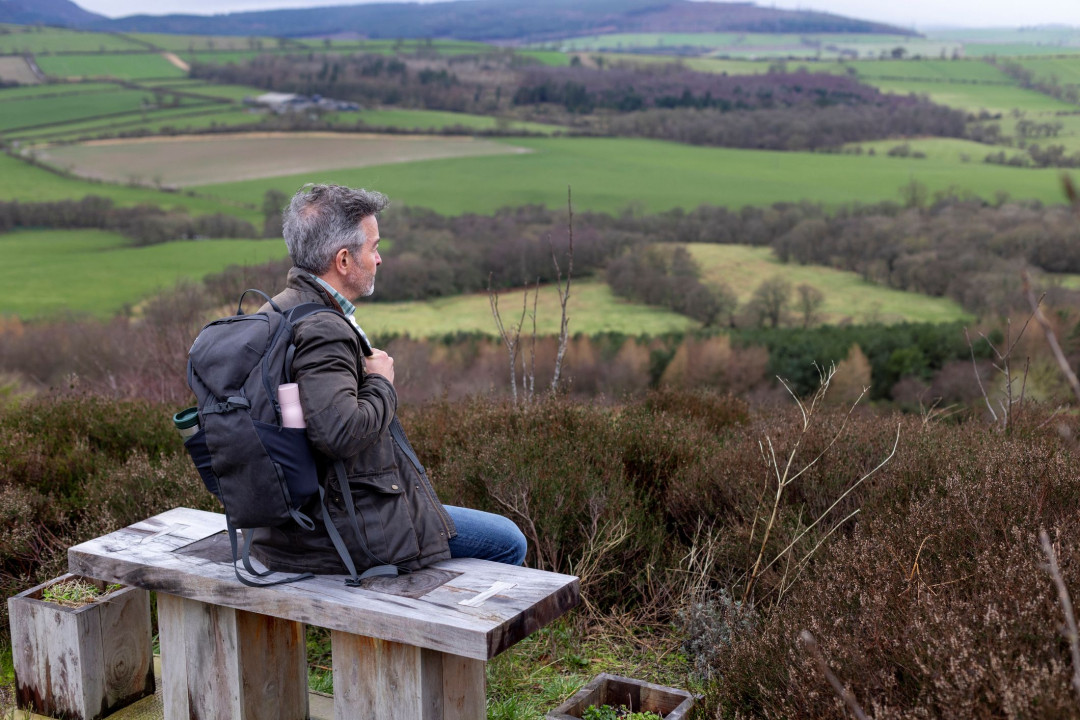
Where we live in North Wales is a beautiful part of the world, but it comes with its challenges. I have to drive everywhere, and we have to travel further to access most services that Elin relies on, like hospital appointments. Generally there’s less going on in the area and support can be harder to come across. Or you have to travel further to find it. I do feel isolated a lot.
I find it really difficult to talk about being a carer. When people ask “what do you do for a living?”, it’s an embarrassing question for me. I can’t tell them I don’t do anything, because that’s not true. Caring is 24/7. But I can’t tell everyone I’m a carer because there’s still a lot of stigma around it. People don’t believe me, or they ask intrusive questions about Elin’s health.
A few years back, I went through a stage of being depressed. The pressure of caring was getting to me and I really couldn’t see a way out. I went to see a doctor and they suggested contacting Carers Outreach Service in Bangor. I’ve had amazing support from them. If I’ve got something to discuss I will always phone them. It’s like they’ve always been there. Sometimes I may feel overwhelmed and the situation gets me down, but I have to try and get my positivity back as soon as I realise. The support I’ve received helps me do this.
It can be hard to get help when you live in a rural area, you just don’t come across it as easily. So I’m always on the lookout and spreading the word. I’m really passionate about it. If I meet someone who is a carer, or sounds like they might be a carer but doesn’t realise, I will give out information and let them know who to speak to. Carers Outreach Service was so helpful to me, and that support was a lifeline. So I wanted to give something back.
About Carers Outreach Support
Linda Kinani from Carers Outreach Support says:
“Like Martin says, caring in a rural area can come with unique challenges. Public transport isn’t easy for a lot of carers, it can take all day on public transport if you have no car. And even if you do drive, the cost of fuel really adds up. It’s also not just the travel issues in rural areas, in some parts the internet isn’t very reliable, and a high proportion of older people especially aren’t digitally savvy. So there’s a huge risk of isolation.
We do have to adapt our approach, as we operate in very rural areas. We are constantly trying to find new ways to find people. It’s not the same as being in a city where it’s easier for people to access support. We have to go out into the community and meet people where they’re at. We want to make sure every carer who needs support can access it, in ways that work for them. We do the best we can. We have an outreach worker whose main role is to travel to different community hubs (run by Local Authorities) to give out information and hold drop-in sessions.
It’s a great way to reach people who we otherwise wouldn’t, and the best thing is they’re on people’s doorsteps – in places like librarie and community centres which often already have a strong sense of community and are already well attended. Often in small villages, it seems that everyone knows everyone – which often works in our favour as people tend to be more trusting of us. We have great relationships with the Local Authorities which helps with referrals. And we get lots of referrals from friends or neighbours, so people don’t feel like they’re asking for help from an anonymous organisation.”
If you’re a carer looking for support in your community, visit the Carers Trust website to find help near you.